Buy Robotic Egg Handling Equipment
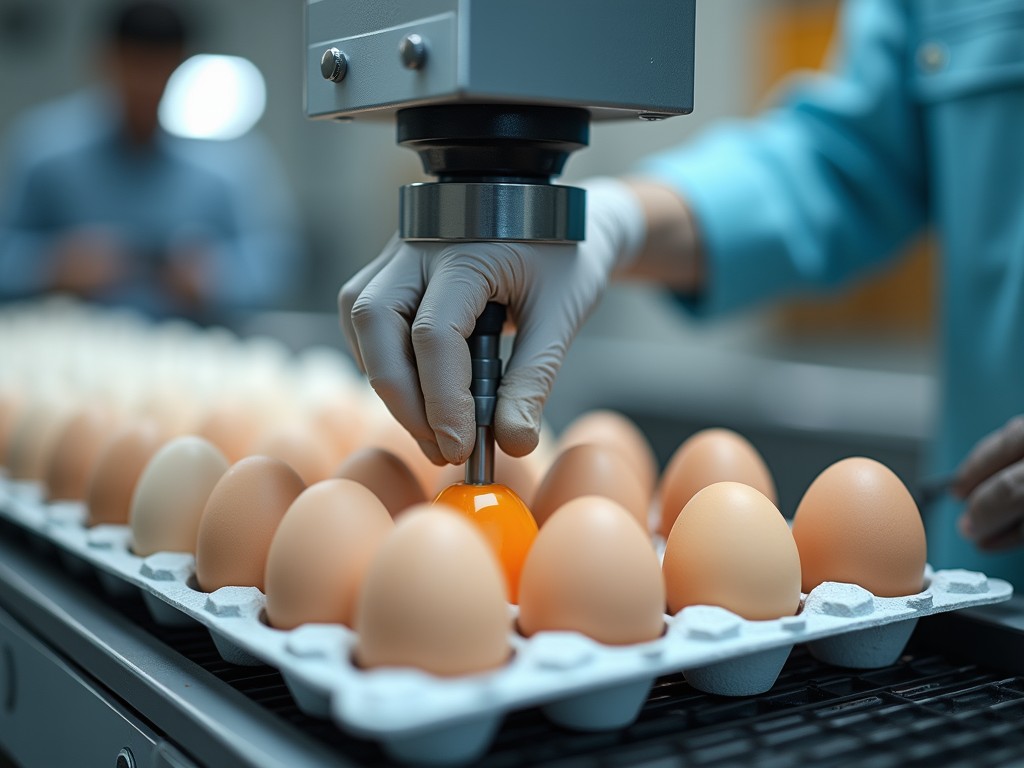
Robotic Egg Handling Equipment
Robotic egg handling equipment automates the transfer of fragile shells from collection trays to processing lines while maintaining precise orientation and minimizing micro‑cracks.
The system typically achieves a repeatability of ±0.2 mm and can handle up to 30 eggs per second depending on gripper design.
Technical Specifications
Key performance parameters include payload capacity, cycle time, vision system resolution, and required footprint.
These values are presented as typical ranges; exact figures are adjusted to match line speed and egg size.
Custom drives and controllers allow synchronization with upstream conveyors and downstream washers.
Specification Table
| Parameter | Typical Value | Customizable Options |
|---|---|---|
| Payload per gripper | 0.05 kg (≈1 egg) | Up to 0.15 kg with vacuum or mechanical fingers |
| Cycle time | 0.8 s per pick‑place | 0.4 s–1.2 s adjustable via servo tuning |
| Vision resolution | 0.1 mm pixel size | 0.05 mm available for high‑speed inspection |
| Footprint (L×W) | 1200 mm × 800 mm | Modular extensions up to 2000 mm length |
| Ingress protection | IP65 (wash‑down ready) | IP69K for high‑pressure cleaning |
Design Considerations
Frames are constructed from 304 stainless steel with electropolished finish to resist corrosion in humid environments.
End‑effectors use food‑grade silicone or polyurethane gels that provide a gentle grip while allowing rapid release.
Drive motors are sealed, rated for continuous duty, and equipped with encoders delivering feedback for closed‑loop control.
Applications in Egg Processing
In hatcheries, the equipment moves fertilized eggs from incubators to candling stations without inducing vibration that could affect embryo viability.
For table‑egg plants, it transfers graded eggs from conveyor belts to packaging lines, reducing manual handling and associated shell fractures.
By maintaining consistent orientation, the system supports downstream processes such as laser marking or oiling, where positional accuracy influences throughput.
Overall line efficiency improves because the robot can operate continuously at the line’s takt time, eliminating bottlenecks caused by labor shifts.
Customization Options
- Interchangeable grippers: vacuum cups, mechanical fingers, or soft‑gel pads
- Conveyor interface kits: side‑mount, overhead, or integrated roller tables
- Software: PLC‑based control, ROS‑compatible API, or standalone touchscreen
- Safety: light curtains, safety‑rated stops, and collaborative speed limits
- Environmental: heated grippers for cold‑room operation or corrosion‑resistant coatings for high‑humidity zones
Quality Assurance
Each unit undergoes a 48‑hour run‑test with simulated egg loads to verify repeatability and thermal stability.
Material certificates and weld inspection reports are provided with every shipment, and optional third‑party validation can be arranged upon request.
To discuss configuration options for your facility, submit a request for quotation.



