Bulk Full Automatic Column Palletizer Manufacturer
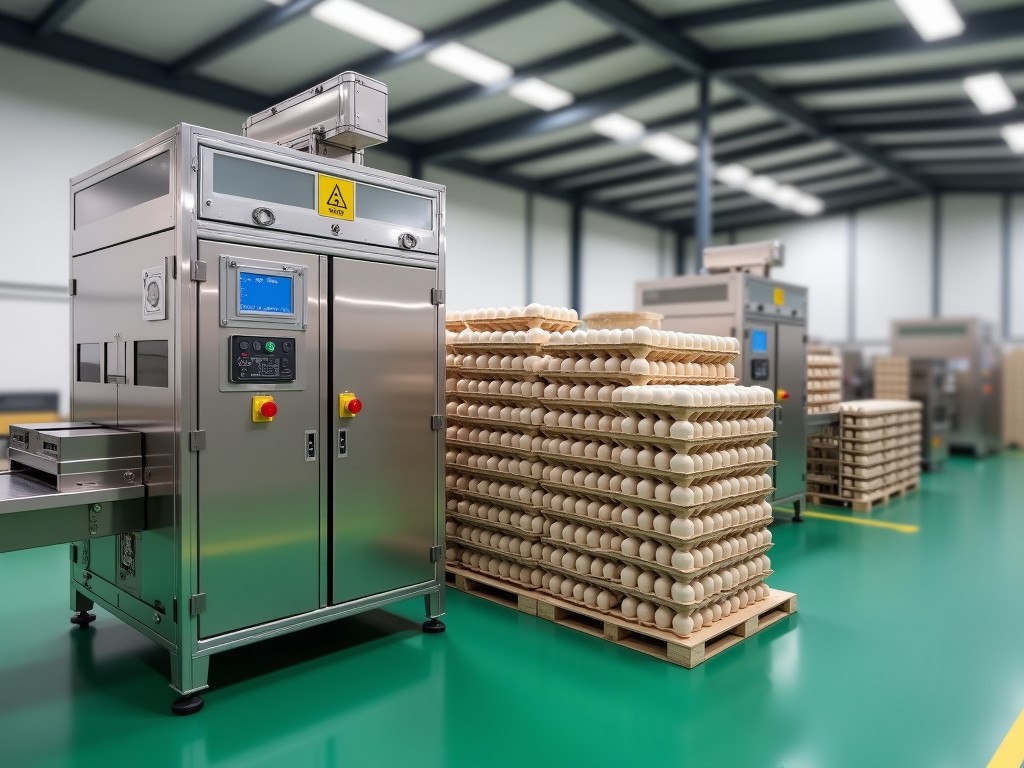
Bulk Full Automatic Column Palletizer
The bulk full automatic column palletizer is a stationary system designed to stack unit loads onto pallets in a vertical column configuration without operator intervention.
Key Technical Specifications
| Parameter | Typical Value |
|---|---|
| Maximum load per layer | Up to 1,500 kg (customizable) |
| Number of layers per column | Up to 10 (adjustable) |
| Cycle time per pallet | ≈ 8 seconds (depends on product dimensions) |
| Footprint (L × W) | ≈ 2.2 m × 1.8 m (base frame) |
| Installed power | ≈ 3.5 kW (servo drives) |
| Control system | PLC‑based with HMI, Ethernet/IP optional |
Operating Principle
Products arrive on an infeed conveyor and are transferred to a lifting mechanism that places each layer onto a stationary pallet column.
After a layer is positioned, a vertical lift raises the completed column by one layer height, allowing the next layer to be stacked directly underneath.
The process repeats until the preset column height is reached, at which point the full pallet is discharged via an outbound conveyor or pallet jack.
All movements are synchronized by servo motors and monitored by position encoders to maintain repeatable placement within ±2 mm.
Typical Applications
- Bagged goods such as fertilizer, cement, or feed where stable column stacking reduces shifting during transport.
- Cartoned beverages or food products that benefit from uniform vertical alignment for automated stretch‑wrapping.
- Intermediate bulk containers (IBCs) and drums that require precise centering to avoid tipping in downstream handling.
- Packaged chemicals or powders where minimizing manual handling improves safety and compliance with OSHA regulations.
Customization Options
- Adjustable layer height ranging from 100 mm to 300 mm to accommodate different product thicknesses.
- Optional rotating turntable for radial product orientation before layer placement.
- Choice of stainless‑steel (AISI 304/316) or painted carbon‑steel frames for corrosive environments.
- Integration with upstream case sealers, weigh‑scale stations, or downstream pallet wrappers via modular conveyor interfaces.
- Software recipes that store up to 20 product profiles for rapid changeover.
Quality Control & Testing
Each unit undergoes factory acceptance testing that includes load‑capacity verification, cycle‑time measurement, and positional accuracy checks.
Electrical components are inspected against IEC 60204‑1 standards, and safety interlocks are validated per ISO 13849‑1.
Documentation provides traceability of critical welds, material certifications, and calibration records for drives and sensors.
Frequently Asked Questions
| Question | Answer |
|---|---|
| Can the column height be adjusted after installation? | Yes, the lift stroke is configurable via the HMI; mechanical stops can be repositioned to suit new layer heights. |
| What information is required for a quotation? | Product dimensions, weight per layer, desired throughput (pallets per hour), inlet/outlet conveyor heights, and any environmental constraints (e.g., wash‑down, explosive atmosphere). |
| Which materials are available for the frame? | Standard is painted carbon steel; optional stainless steel grades 304 or 316 for corrosive or hygienic settings. |
| How is quality inspected before shipment? | Factory acceptance test includes load testing at 110 % of rated capacity, speed validation, and safety‑function verification; a test report is supplied with each unit. |
| What packaging methods are available for export? | Units are disassembled into transport‑ready modules, wrapped in stretch film, and secured in ISPM‑15 compliant wooden crates or steel frames. |
| What is the typical production lead time? | Lead time ranges from 8 to 12 weeks after receipt of approved drawings and deposit, depending on configuration complexity. |



