B2B Robot Arm Egg Crate Packing Machine
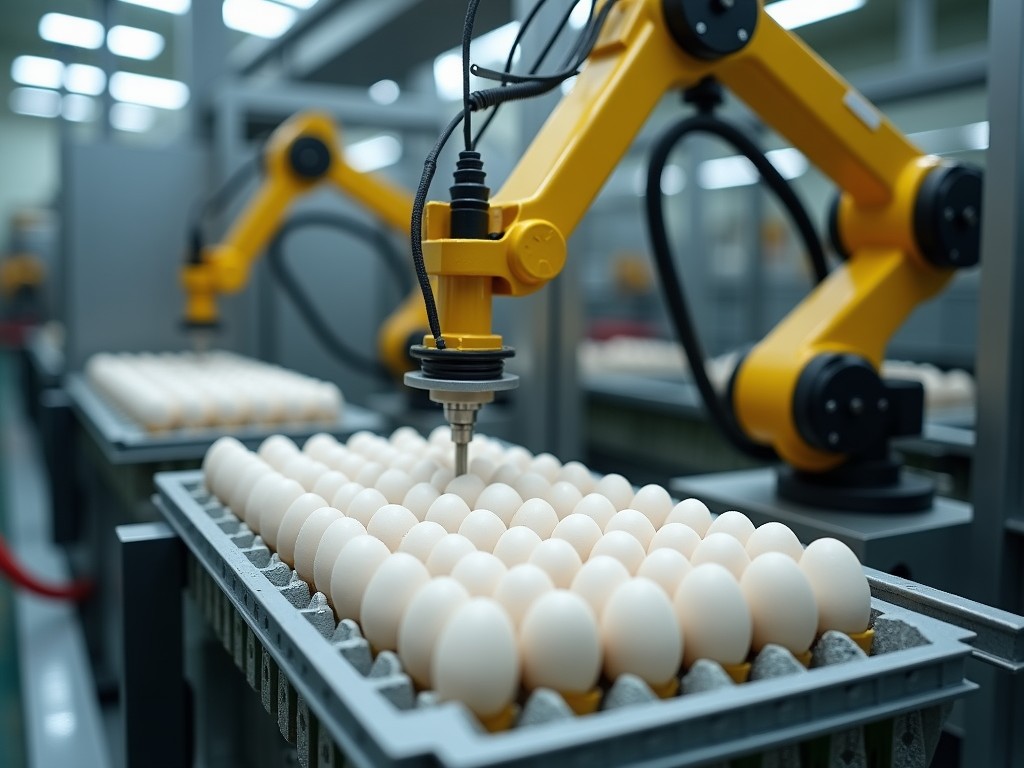
B2B Robot Arm Egg Crate Packing Machine
This system combines a six‑axis articulated robot with a custom end‑effector designed to grasp and place eggs into standard 30‑egg crates at rates up to 90 crates per hour. Integrated vision sensors locate each egg’s orientation, allowing the gripper to adjust tilt and avoid shell damage.
Key Technical Specifications
| Parameter | Typical Value | Notes |
|---|---|---|
| Robot axes | 6 | Revolute joints |
| Maximum payload | 5 kg | Includes gripper and crate |
| Reach (horizontal) | 800 mm | From robot base to wrist flange |
| Repeatability | ±0.02 mm | Measured at TCP under ISO 9283 |
| Cycle time per crate | 1.2 s | Includes pick, place, and return |
| Power consumption | 1.5 kW (peak) | Three‑phase 400 V |
| Control system | PLC‑based with EtherCAT bus | Supports IEC 61131‑3 programming |
| Safety rating | PL d, Category 3 | ISO 13849‑1 |
Operational Principle
Eggs are delivered on a vibratory feeder that aligns them in a single lane. A 2D vision system captures the position and orientation of each egg as it passes a checkpoint. The robot controller computes a grasp pose that compensates for egg tilt, then commands the arm to move to the egg, engage a soft‑pneumatic gripper, lift, and transport the egg to the corresponding cavity in a moving crate.
The crate rides on a belt conveyor synchronized with the robot’s cycle. After placement, the gripper opens, the arm retracts to a home position, and the conveyor advances the crate by one pitch. The process repeats until the crate is full, at which point a full‑crate detector triggers a divert to the packaging line.
All motions are interpolated using cubic splines to limit jerk, reducing mechanical stress on the egg shell and extending gripper life.
Applications in Egg Processing
In high‑volume laying farms, manual crate filling creates variability in packing speed and increases the risk of micro‑cracks due to inconsistent handling. By automating the transfer, the robot arm maintains a constant force profile, which studies show reduces shell fracture rates from 0.8 % to below 0.2 % under comparable throughput.
The machine can be integrated into existing grading and washing lines without major layout changes; its footprint is 1.2 m × 0.8 m, and it requires only a 400 V three‑phase supply and a compressed air line at 6 bar for the gripper.
Customization Options
- Gripper material: FDA‑approved silicone, nitrile, or polyurethane with selectable Shore hardness.
- Crate size adapters for 20‑egg, 30‑egg, or 36‑egg configurations.
- Vision system upgrade: monochrome or color CMOS, adjustable illumination wavelengths.
- Software add‑ons: production tracking OEE dashboard, remote diagnostics via MQTT.
- Safety enhancements: area scanners, safety‑rated speed reduction zones.
Quality Control and Testing
Before shipment, each robot arm undergoes a pose accuracy test using a laser tracker; the measured error must stay within ±0.02 mm across the full workspace. Gripper closing force is calibrated with a load cell to ensure a range of 1 N‑5 N, preventing egg slip or over‑compression.
The completed machine runs a 48‑hour soak test at 80 % duty cycle, logging cycle times, motor temperatures, and vibration levels. Any deviation beyond 5 % from baseline triggers a review.
Frequently Asked Questions
Yes. The vision system measures egg diameter and adjusts the gripper opening accordingly; the standard configuration covers eggs from 48 mm to 56 mm.
What information is needed for a quotation?Required details include crate dimensions, desired packs per hour, facility power specifications, and any environmental constraints such as wash‑down rating.
Is the machine suitable for organic‑egg lines?All contact surfaces use food‑grade, corrosion‑resistant materials compliant with FDA 21 CFR 177.2600, making it appropriate for organic and conventional lines.
Next Steps
To discuss how this robot arm egg crate packing machine can be tailored to your production line, please use the links below.



