B2B Collaborative Palletizing Robot Manufacturer
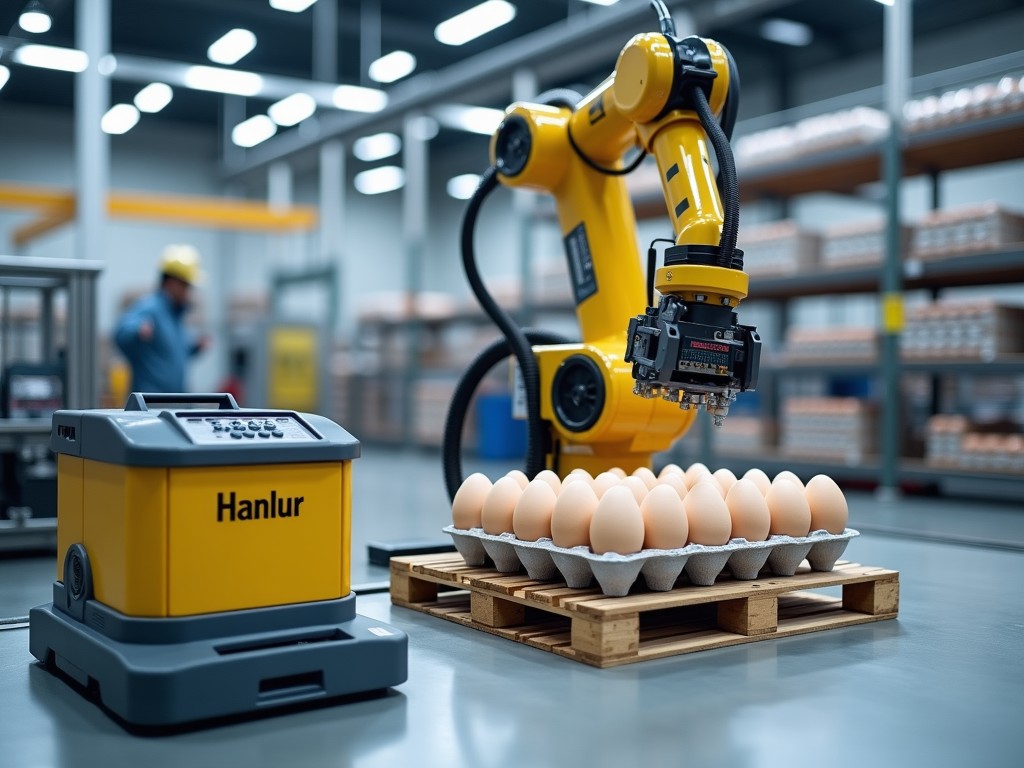
B2B Collaborative Palletizing Robot Manufacturer
Selecting a palletizing solution requires understanding how the robot’s mechanical design, control architecture, and safety system interact with the production line. This page outlines the engineering considerations that differentiate collaborative palletizing robots from traditional, caged alternatives, focusing on measurable performance parameters and integration practicalities.
Key Technical Characteristics
Payload capacity typically ranges from 5 kg to 20 kg, enabling handling of common consumer‑goods cases, cartons, and trays without exceeding the robot’s wrist torque limits. Reach varies between 800 mm and 1300 mm, allowing coverage of standard pallet dimensions (1200 mm × 1000 mm) from a single base position. Maximum TCP speed is limited to 250 mm/s in collaborative mode to satisfy ISO/TS 15066 force and pressure thresholds, while higher speeds are available in segregated zones when safety scanners detect absence of personnel.
Joint repeatability is specified at ±0.02 mm, a figure verified through laser interferometer testing over 10 000 cycles. Cycle time for a typical 12‑layer pallet (assuming 2 s pick, 1.5 s place, 0.5 s travel) averages 45 seconds per pallet, a value that can be refined based on actual product dimensions and conveyor synchronization. Power consumption averages 1.2 kW during operation, with regenerative braking returning up to 15 % of energy to the supply during deceleration phases.
Design and Construction
| Parameter | Typical Value / Option |
|---|---|
| Base footprint | 400 mm × 400 mm square, height 150 mm |
| Arm material | Aluminum alloy 6061‑T6, anodized for corrosion resistance |
| Wrist housing | Stainless steel 304, sealed to IP65 |
| Cable management | Internal routed through hollow joints, PVC‑free, rated for 10 million flex cycles |
| Mounting interface | ISO 9409‑1‑50‑4‑M6 pattern, optional adaptive plates for non‑standard bases |
The robot’s structure employs a modular link design where each joint incorporates a harmonic drive with a torque sensor integrated into the output flange. This arrangement enables direct force feedback without external torque sensors, reducing wiring complexity and improving response time to under 8 ms for force‑limit activation.
Covers and guards are fabricated from UV‑stabilized polycarbonate, providing impact resistance while maintaining transparency for visual inspection. All fasteners are metric, grade 8.8, with thread‑locking patches to prevent loosening under vibration.
Safety and Compliance
Collaborative operation relies on a combination of speed and separation monitoring (SSM) and power and force limiting (PFL). The SSM subsystem uses safety‑rated laser scanners with a 180° field of view, capable of detecting intrusions at distances as low as 0.3 m and initiating a controlled stop within 0.1 s. PFL thresholds are set to 150 N for transient contact and 60 N for quasi‑static contact, values derived from ISO/TS 15066 Annex B guidelines for soft tissue injury prevention.
Safety PLCs are certified to SIL 2 per IEC 61508, with dual‑channel safety inputs for emergency stop, safety gate, and scanner signals. The robot’s firmware includes a safety‑monitored stop category 1 function that maintains power to brakes while removing drive power, ensuring the arm holds position during a safety event.
Electromagnetic compatibility complies with IEC 61000‑6‑2 (immunity) and IEC 61000‑6‑4 (emission), allowing installation in environments with variable frequency drives, welders, and RFID readers without interference.
Integration and Programming
Programming is performed via a teach pendant equipped with a 7‑inch touchscreen, supporting pose‑guided instruction, pallet‑pattern wizards, and custom script execution using a Python‑based API. The controller exposes EtherCAT and PROFINET ports for real‑time I/O, enabling synchronization with conveyor encoders, barcode scanners, and weighing scales.
The robot’s native motion libraries include palletizing building blocks such as layer‑build, interlock, and slip‑sheet insertion, each parameterized by case dimensions, pallet size, and desired stacking pattern. Users can adjust approach and retreat distances, acceleration ramps, and gripper actuation sequences without leaving the teaching interface.
For facilities employing fleet management, the controller supports OPC UA and MQTT publish/subscribe, allowing remote monitoring of joint temperatures, motor currents, and cycle counts. Diagnostic logs are stored locally on an industrial‑grade SSD and can be exported via USB or Ethernet for predictive‑maintenance analysis.
Typical Applications
In beverage bottling lines, the robot handles 2‑liter PET bottles packed in six‑pack cartons, placing them onto pallets at a rate of up to 800 cartons per hour. The low‑profile base allows installation beneath existing conveyor rollers without raising the line height, preserving floor space for ancillary equipment.
For packaged food products such as snack bags or frozen‑food boxes, the robot’s stainless‑steel wrist and IP65 rating enable direct contact with wash‑down environments. End‑effector options include vacuum grippers with adjustable suction pressure (0.2 bar – 0.8 bar) and mechanical parallel grippers with interchangeable finger inserts ranging from 20 mm to 100 mm width.
In consumer‑goods warehouses, the robot performs mixed‑case palletizing where SKU dimensions vary significantly. The vision‑guided pick module, using a 2‑D camera with 5 MP resolution, identifies case orientation and adjusts grasp points in real time, reducing mis‑placements to less than 0.5 % of total cycles.
Customization Options
- Alternative wrist payloads up to 30 kg with reinforced harmonic drives
- Extended reach variants (up to 1600 mm) utilizing carbon‑fiber forearm tubes
- Specialized grippers: magnetic for ferrous cans, clip‑type for trays, and custom tool changers
- Floor‑mount, ceiling‑suspended, or mobile base configurations with autonomous navigation
- Software add‑ons: RFID tag verification, barcode validation, and weight‑check integration
Quality Assurance
Each robot undergoes a 72‑hour endurance test at 80 % of rated duty cycle, monitoring joint temperature rise, vibration spectra, and encoder drift. Acceptance criteria include temperature increase below 20 °C above ambient, vibration amplitude under 0.02 mm RMS, and positional error staying within ±0.05 mm after thermal soak.
Dimensional inspection of critical links is performed using a coordinate‑measuring machine (CMM) with a tolerance of ±0.01 mm. Surface finish of exposed aluminum is verified to meet Ra 0.8 µm to ensure proper sealing and prevent particle accumulation in clean‑room settings.
Final validation includes a safety‑system functional test where simulated contact forces are applied at various speeds, confirming that the PFL and SSM responses meet the prescribed thresholds. Documentation packages contain test reports, calibration certificates, and a declaration of conformity to the Machinery Directive 2006/42/EC.
Frequently Asked Questions
Can the robot’s reach and payload be customized for a specific product?
Yes, both reach and payload are adjustable through selection of forearm length, joint gear ratios, and wrist reinforcement. Exact values are confirmed during the engineering quotation phase based on the provided case weight and pallet layout.
What information is required before a quotation can be issued?
We need the product dimensions (length × width × height), weight, pallet size, desired layers per pallet, line speed (cases per minute), and any environmental constraints such as wash‑down, temperature extremes, or presence of corrosive agents.
Which end‑effector options are available for handling fragile items?
Soft‑touch vacuum grippers with programmable suction pressure, foam‑lined mechanical grippers, and compliant finger inserts are available. Force‑sensor feedback can be integrated to limit grip force to a user‑defined threshold, typically between 5 N and 30 N.
How is quality inspected before shipment?
Each unit passes a functional test cycle, a safety‑system validation, and a visual inspection for cosmetic defects. Test data is retained for traceability and supplied with the shipment documentation.
What packaging methods are used for export shipments?
Robots are secured to a steel skid with shock‑absorbing brackets, covered with UV‑stable shrink wrap, and placed in ISPM‑15 compliant wooden crates. Corner protection and humidity‑indicating cards are included to monitor transit conditions.
What is the typical production lead time?
Lead time ranges from 6 to 10 weeks after receipt of the technical specification sheet and deposit, depending on the selected customization level and current manufacturing load.
Next Steps
Engineering teams are encouraged to share the relevant product and line details to begin a feasibility review. A preliminary layout drawing, cycle‑time estimate, and safety‑zone analysis can be generated within three business days of receiving the specification.
To start the conversation, please use the contact form below or reach out directly to our applications engineering group.
Contact our engineering team


