Automatic Egg Handling Robot Source Factory
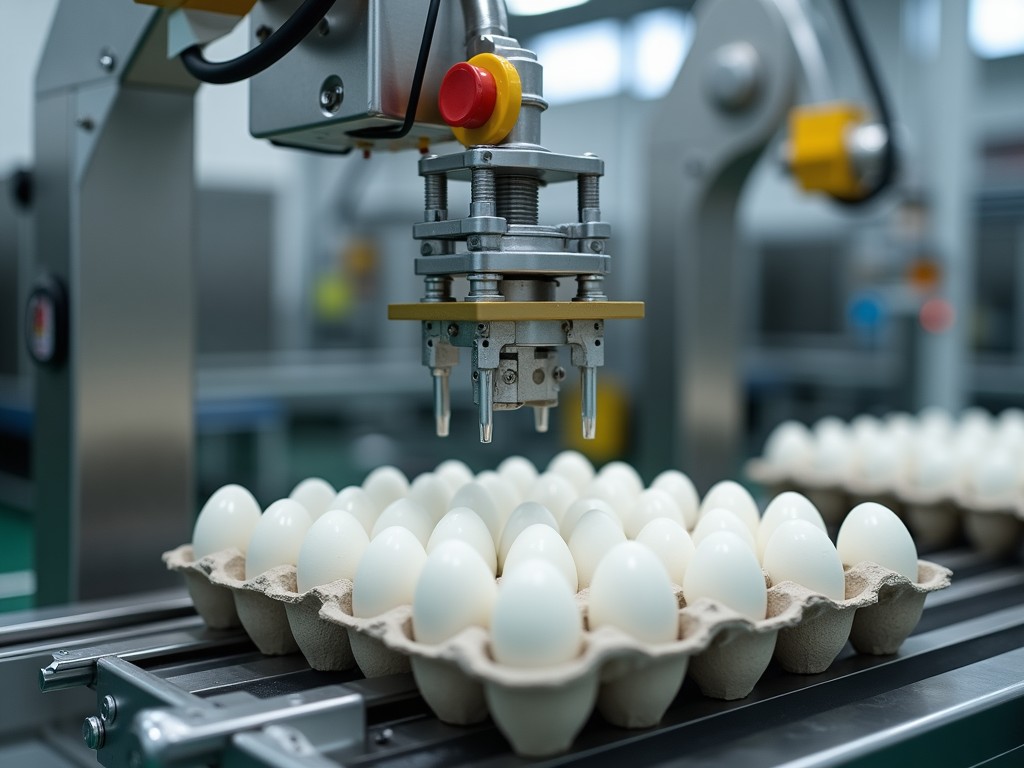
Automatic Egg Handling Robot – Source Factory
This system is designed to transfer table‑egg products from collection belts to packaging lines with minimal manual intervention. It integrates a six‑axis articulated arm, a vision‑guided gripper, and a safety‑rated controller to achieve repeatable placement within ±0.5 mm.
Key Technical Specifications
| Parameter | Typical Value |
|---|---|
| Maximum Payload | 5 kg (including gripper and egg tray) |
| Reach (horizontal) | 800 mm |
| Repeatability (ISO 9283) | ±0.05 mm |
| Cycle Time per Egg | 0.9 s (including pick, move, place) |
| Power Supply | 3‑phase 380 V ± 10 %, 50/60 Hz, 2.2 kW |
| Control Platform | PLC‑based with EtherCAT motion bus, safety‑rated to PLd |
| Ingress Protection | IP65 (arm and controller), IP54 (base) |
| Footprint (L × W) | 1200 mm × 900 mm |
| Operating Temperature | 0 °C – 45 °C (non‑condensing) |
Operational Principle
A stereo vision subsystem locates each egg on the infeed conveyor, calculates its orientation, and sends coordinates to the motion controller. The six‑axis arm then moves to the pre‑grasp pose, activates a soft‑vacuum gripper equipped with compliant silicone cups, lifts the egg, and places it onto the outbound tray at a programmed pitch.
The controller monitors grip force via integrated pressure sensors; if slip is detected, the routine aborts and signals the line for manual inspection. All motions are confined to a safety‑rated zone monitored by laser scanners, ensuring compliance with ISO 13849‑1.
Design Features
- Modular wrist allowing quick change between vacuum, mechanical, or hybrid grippers.
- Self‑lubricating harmonic drives on axes 2‑4 to maintain repeatability over >10⁶ cycles.
- Energy‑regenerative braking reduces peak power draw by ~18 % during deceleration phases.
- Tool‑change mechanism completes gripper swap in < 45 seconds without production stop.
- Enclosed cable management with IP68‑rated connectors prevents contamination from egg debris.
Applications in Poultry Processing
The robot handles fresh table eggs directly from washing and drying stations, where surface moisture and slight variations in egg shape challenge manual labor. By providing consistent orientation, it reduces crack rates in downstream packaging lines typically associated with uneven loading.
In hatchery operations, the unit can transfer fertile eggs to incubators with minimal rotation, preserving embryo viability. Its low‑vibration motion profile (< 0.02 g RMS) meets the stringent handling standards for embryonated eggs.
Customization Options
- Adjustable working envelope: reach from 600 mm to 1000 mm, payload up to 8 kg.
- Alternative grippers: magnetic for steel‑tray handling, or soft‑foam for delicate products.
- Integration kits for existing PLC brands (Siemens, Rockwell, Schneider) via PROFINET, EtherNet/IP, or Modbus TCP.
- Clean‑in‑place (CIP) compatible surfaces with electropolished stainless steel (304L) for high‑hygiene zones.
- Optional secondary vision system for barcode or date‑code verification post‑placement.
Quality Assurance & Testing
Each unit undergoes a 48‑hour endurance test at 120 % of rated cycle speed, monitoring joint temperature, vibration, and positional drift. Acceptance criteria require drift < 0.1 mm after the test period.
Safety validation includes emergency stop response time (< 150 ms) and protective stop distance measured per ISO 13855. Documentation provides a test report, CE declaration of conformity, and a detailed bill of materials with material traceability.
Frequently Asked Questions
A: Yes. The robotic base and arm lengths are selectable modules; reach can be set between 600 mm and 1000 mm, and payload capacity adjusted up to 8 kg by changing drive ratios and motor sizing.
A: Line speed (eggs per minute), infeed and outfeed conveyor heights, available utilities (voltage, air pressure), and any environmental constraints (temperature, washdown requirements).
A: Food‑grade silicone (shore A 30‑45) for vacuum cups, and stainless‑steel (316L) fingers for mechanical grippers, both compliant with FDA 21 CFR 177.2600.
A: Functional testing includes cycle accuracy, force feedback validation, and emergency stop verification. Visual inspection checks weld integrity, surface finish, and labeling.
A: The robot is secured on a steel pallet with shock‑absorbing foam corners, wrapped in VCI film, and placed inside a ISPM‑15‑certified wooden crate.
A: Standard configurations ship within 6‑8 weeks after receipt of purchase order; customized units require an additional 2‑3 weeks for engineering approval.
Contact for Inquiry
To discuss how this egg handling robot can be integrated into your processing line, please submit a request with your line specifications. Our engineering team will respond with a feasibility study and preliminary layout within two business days.



