Auto Robotic Egg Tray Loader Source Factory
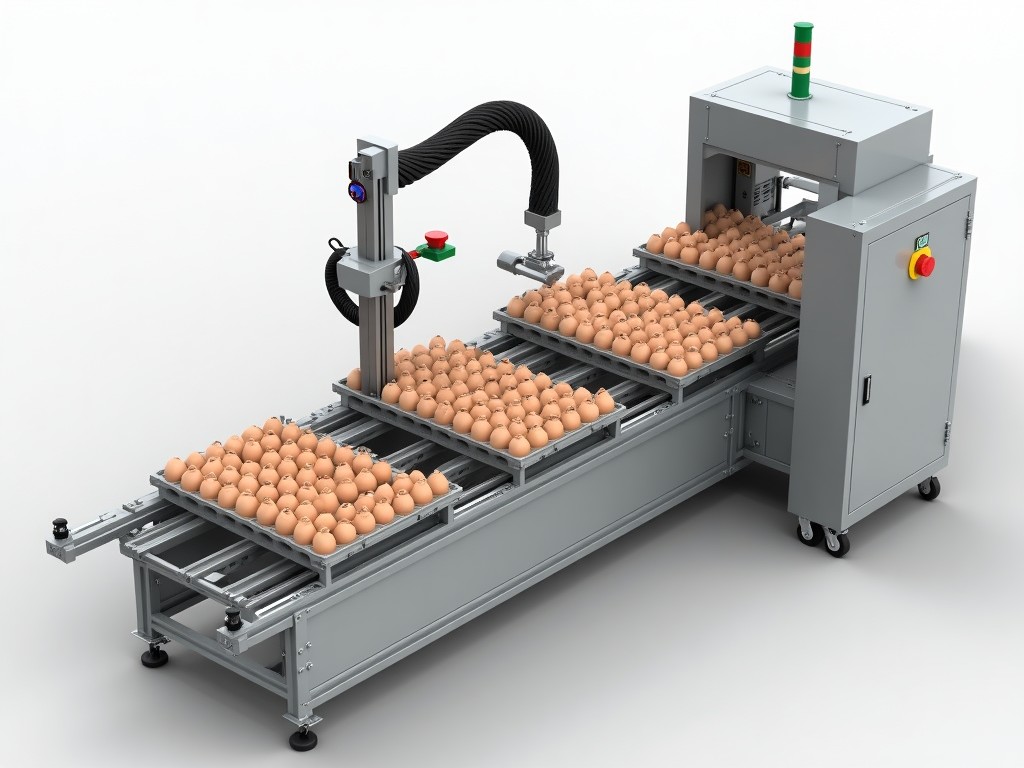
Auto Robotic Egg Tray Loader – Source Factory Solution
The auto robotic egg tray loader is designed to transfer formed egg trays from a molding line to downstream packing or palletizing stations with minimal human intervention. It combines a Cartesian or articulated robot arm with a vision-guided gripper that adapts to variations in tray dimensions and stack height. By automating this repetitive transfer, manufacturers reduce labor fatigue, improve line balance, and lower the risk of tray damage during handling.
Typical installations achieve cycle times between 0.8 and 1.2 seconds per tray, depending on gripper design and conveyor speed. The system can be synchronized with existing tray conveyors using standard digital I/O or fieldbus interfaces such as EtherCAT or Profinet. Load capacity is generally rated for trays up to 500 g each, with a maximum stack weight of 25 kg per cycle.
Because the loader operates in a clean, dry environment typical of egg processing plants, materials of construction focus on corrosion resistance and ease of cleaning. Stainless steel 304 or 316L is commonly used for structural frames, while gripper components may employ food‑grade polymers or coated aluminum to prevent product contact contamination.
Core Technical Specifications
| Parameter | Typical Value / Range |
|---|---|
| Robot Type | 6‑axis articulated or Cartesian gantry |
| Maximum Payload | 5 kg (including gripper and tray) |
| Repeatability | ±0.1 mm |
| Cycle Time | 0.8–1.2 s per tray |
| Power Supply | 380 V ±10 % 3‑phase, 50/60 Hz |
| Control Interface | Digital I/O, EtherCAT, Profinet, Modbus TCP |
| Operating Temperature | 5 °C – 45 °C (controlled indoor environment) |
| Ingress Protection | IP54 for robot arm, IP65 for controller enclosure |
Operational Principles
A vision system mounted above the tray exit captures the position and orientation of each tray as it leaves the forming station. The controller processes this data to compute the optimal pick point and approach trajectory for the robot arm. The gripper, equipped with compliant fingers or vacuum cups, secures the tray without applying excessive force that could deform the pulp structure.
After pickup, the robot moves the tray along a predefined path to the discharge conveyor, where it releases the load using a timed opening sequence. Sensors verify successful placement before the next cycle begins. If a mispick is detected, the system initiates a retry routine or alerts the operator via the HMI, minimizing downtime.
Energy consumption is primarily driven by the robot’s servo drives; typical average power draw during continuous operation ranges from 1.2 kW to 1.8 kW, depending on payload and motion profile. Regenerative braking features can recover a portion of this energy during deceleration phases.
Key Design Features
- Modular gripper kit allows quick change‑over between tray sizes ranging from 10 × 10 cm to 30 × 30 cm.
- Integrated safety laser scanners create a protected zone; the robot stops immediately if personnel enter the workspace.
- Self‑diagnostic firmware logs motor torque, joint temperature, and cycle counts for predictive maintenance.
- Frame constructed from laser‑cut stainless steel sheets with TIG‑welded joints, providing high torsional rigidity and resistance to cleaning agents.
- Optional conveyor speed encoder feedback enables dynamic synchronization with upstream equipment without external PLC programming.
Integration & Compatibility
The loader’s control module accepts standard 24 V DC digital signals for start, stop, and fault reset, making it compatible with most existing line controllers. For higher‑speed lines, EtherCAT or Profinet connections provide real‑time trajectory updates with sub‑millisecond jitter.
Mechanical mounting interfaces include adjustable base plates and optional isolation pads to accommodate varying floor levels and vibration characteristics. The unit’s footprint is typically 1200 mm × 800 mm × 1800 mm (L × W × H), but can be scaled by adjusting the robot’s reach axis length.
Software libraries are provided for common PLC brands (Siemens, Allen‑Bradley, Mitsubishi) to map I/O and motion commands, reducing integration time to under two days for experienced system integrators.
Customization Options
- Gripper configurations: vacuum suction cups for lightweight trays, mechanical fingers for heavier or textured trays.
- Vision system upgrades: higher resolution cameras, multi‑spectral lighting for varied tray colors.
- Extended reach: additional linear axes to increase working envelope up to 2500 mm.
- Enclosure upgrades: stainless steel 316L for wash‑down environments, IP66 rating.
- HMI packages: touchscreen panels with recipe management, OEE tracking, and remote diagnostics via Ethernet.
Quality Assurance & Testing
Before shipment, each unit undergoes a factory acceptance test (FAT) that includes repeatability verification, cycle‑time measurement under load, and vision system accuracy checks. Test trays representative of the customer’s specifications are used to confirm proper grip force and placement tolerance.
All welded seams are inspected via dye‑penetrant testing to ensure absence of cracks. Stainless steel passivation is performed to enhance corrosion resistance, especially in environments with frequent cleaning cycles.
Documentation provided with each shipment includes material certificates, electrical schematics, CE conformity declaration, and a detailed maintenance schedule outlining lubrication points, belt tension checks, and firmware update procedures.
Applications in Poultry Processing
Egg tray loading is a bottleneck in high‑volume hatcheries where thousands of trays per hour must be moved from forming machines to packing lines. Manual handling introduces variability in tray orientation, increasing the risk of misfeeds in downstream cartoners or palletizers.
By automating the transfer with a vision‑guided robot, the loader guarantees consistent tray placement, which improves carton sealing reliability and reduces product breakage. The system’s ability to adapt to varying tray stack heights accommodates both single‑layer and double‑layer tray formats without mechanical retooling.
In addition, the enclosed design minimizes exposure of trays to airborne contaminants, supporting hygiene standards required for food‑grade packaging operations.
Frequently Asked Questions
Can the loader be customized for non‑standard tray dimensions? Yes, the gripper and vision parameters are adjustable; customers provide tray drawings or samples for engineering validation.
What information is needed before a quotation? Required data include tray size and weight, desired cycle time, line speed, available utilities (voltage, air pressure), and integration preferences (I/O or fieldbus).
Which materials are available for the frame and gripper? Frame options are stainless steel 304 or 316L; gripper components can be food‑grade PU, acetal, or coated aluminum depending on contact requirements.
How is quality inspected during production? Each unit undergoes FAT, visual weld inspection, dimensional verification of critical interfaces, and functional testing of safety systems.
What packaging methods are used for export shipments? Units are secured on pallets with corner protectors, stretch‑wrapped, and placed in ISPM‑15 compliant wooden crates or steel frames as per destination requirements.
What is the typical production lead time? Lead time ranges from 6 to 8 weeks after receipt of technical specifications and deposit, subject to current workload.
How are samples arranged? Sample trays or prototype gripper kits can be shipped upon request; customers cover freight and any applicable handling fees.



